
Getting users from traditional finance into crypto still creates the most friction in onboarding. It looks simple until real users start going through the flow. Payments fail, KYC slows everything down, and unfamiliar steps make people drop off before they even complete their first transaction. For any product that depends on user activation, this stage defines whether growth actually happens.
The choice of the on-ramp plays a bigger role than it seems. Payment methods, approval rates, and how clean the UX feels all affect conversion. Some tools prioritize speed, others focus on compliance or flexibility. The goal here is to look at how these platforms behave in practice and what they actually offer when you try to plug them into a real product.
1. Paybis
For retail users who want to buy Bitcoin right now with a credit card and minimal friction, Paybis delivers instant purchases with 24/7 customer service, serving 48 U.S. states and 180+ countries—a rare combination of speed and geographic reach.
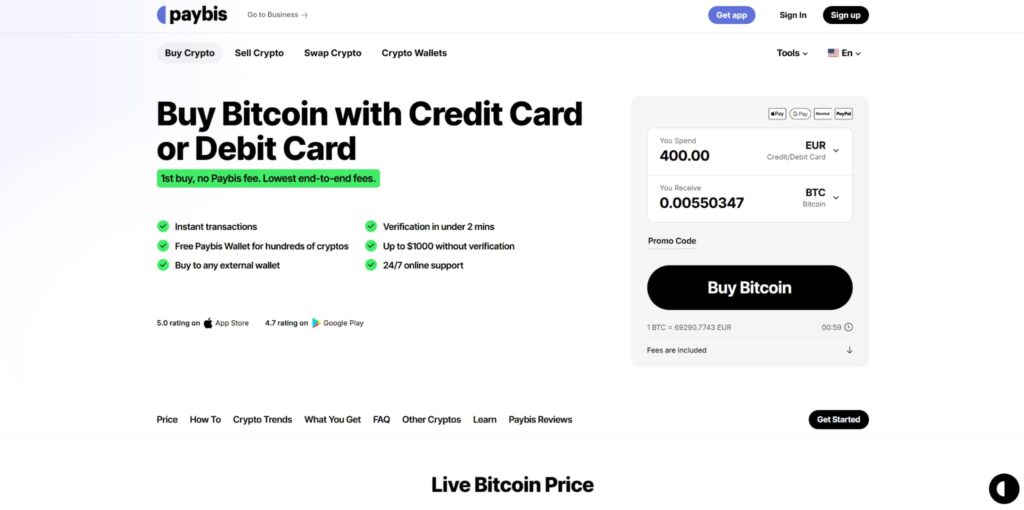
Paybis focuses on direct purchases and keeps the process simple for first-time users. The platform has been operating since 2014 and is available across most states in the United States as well as over 180 countries. It allows users to buy crypto using cards without going through complicated flows. Support is available around the clock, which helps resolve failed payments or verification issues quickly. The whole setup is designed to reduce friction at the moment users enter the system.
Where Paybis Works Best
Paybis works well in retail-oriented flows where speed matters more than flexibility. It is often used in products that require users to complete a purchase quickly without learning how crypto works. The interface stays simple, and the process is short enough to keep users from dropping off. At the same time, it does not offer deep customization for platforms that want to fully control the experience. That makes it more suitable for direct usage than for complex embedded solutions.
To understand what the platform actually provides, here are its main capabilities:
- Card-based crypto purchases for fast onboarding;
- Global coverage across multiple regions;
- Built-in wallet for storing assets;
- Staking options for passive income;
- Simple conversion between fiat and crypto.
These features make it effective for quick onboarding, though less flexible for advanced integrations.
The trade-off: Paybis is optimized for direct-to-consumer flows rather than white-label embedding, so platforms looking for fully branded checkout experiences may find integration options more limited than enterprise-focused competitors.
2. MoonPay
With nearly 30 million customers and powering the infrastructure for nearly 500 companies across the decentralized economy, MoonPay is a key driver behind mainstream crypto adoption, making it the go-to choice for platforms that need proven scale and enterprise-grade reliability.

MoonPay is designed to handle large user flows without turning onboarding into a bottleneck. Since 2019, it has been picked up by a wide range of apps that need a simple way for users to buy crypto without learning anything new. Payments work through familiar methods like cards, Apple Pay, PayPal, and Venmo, so the process feels привычным from the first step. This reduces drop-off and keeps the flow clean even when traffic grows. For teams dealing with scale, that consistency matters more than anything else.
Where MoonPay Works Best
MoonPay works well in products where onboarding needs to be smooth and predictable. It is often used in apps that bring in a steady stream of new users every day. The platform takes care of payments, compliance checks, and delivery in the background, which saves time on the product side. The trade-off is that pricing is not clearly laid out, so you usually need to go through discussions before understanding the real cost.
To see how it performs in practice, here are its key functions:
- Crypto purchases using common payment methods;
- Sell and trade functionality inside the same flow;
- Support for Apple Pay and PayPal transactions;
- Infrastructure for large-scale onboarding;
- API-driven integration for products.
This setup makes MoonPay reliable for scale, even if cost transparency is limited.
3. CoinGate
As one of the first MiCA-licensed providers in the EU, CoinGate offers a stronger level of trust and legal certainty than most alternatives, making it the smart choice for merchants who need regulatory clarity alongside technical flexibility.

CoinGate is built with regulated markets in mind and takes a more controlled approach to handling crypto payments. The platform has been around since 2014 and aligns with EU requirements, which makes it easier to work with in environments where compliance is not optional. It supports a range of cryptocurrencies and gives the option to convert incoming payments into EUR or stablecoins right away. That way, businesses don’t have to sit on volatile assets after each transaction.
Where CoinGate Works Best
CoinGate makes sense for teams that need a balance between flexibility and regulatory clarity. It can be connected through plugins or integrated via API, so it fits both simple setups and more custom systems. The platform also supports crypto refunds and payouts, which becomes useful once flows get more complex. It may not feel as fast during onboarding, but it gives more control over how payments are handled.
To understand its capabilities, here are the key features:
- Support for multiple cryptocurrencies;
- Instant conversion into EUR or stablecoins;
- Integration via API and e-commerce plugins;
- Payment buttons and invoicing tools;
- Crypto payouts and refunds.
This makes CoinGate suitable for structured environments where compliance matters.
The platform also supports Crypto payouts and Customer refunds in crypto, which matters for platforms that need to reverse transactions or pay affiliates in crypto. The main gap: no documented team size or customer count, making it harder to gauge operational scale compared to MoonPay’s 30M user base.
4. Swapin
Swapin’s elegant solution allows clients to pay in crypto while businesses receive fiat instantly with no volatility, no complexity, and no chargebacks—a compelling value proposition for platforms that want crypto’s benefits without treasury risk.
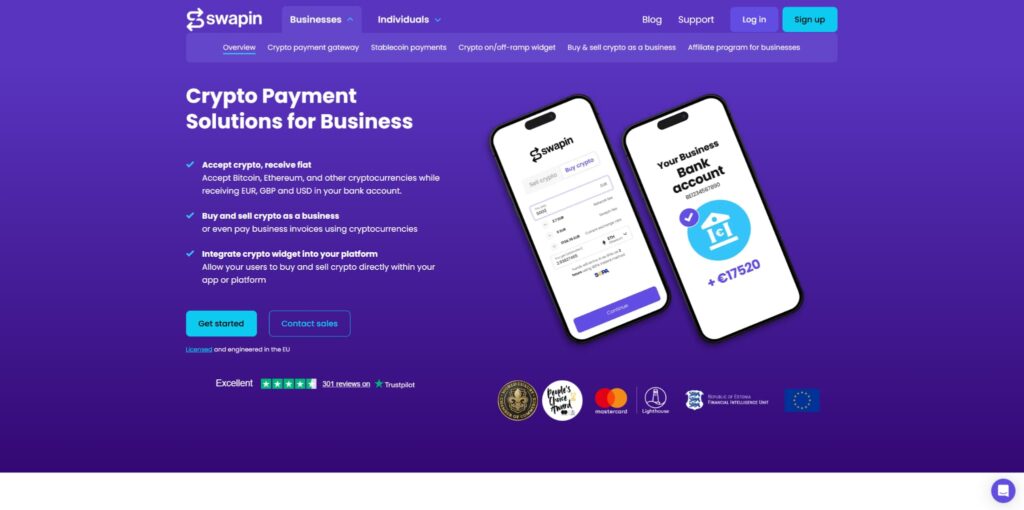
Swapin is built around one idea: accept crypto but receive fiat instantly. The platform has been active since 2017 and operates under EU licensing. It connects crypto payments directly with banking infrastructure, which removes the need to hold digital assets. This is useful for businesses that want to avoid volatility completely.
Where Swapin Works Best
Swapin fits companies that prefer predictable payouts. It is often used in environments where accounting needs to stay simple and compliant. Payments can be processed quickly, and funds arrive in bank accounts without manual conversion. The platform also supports different integration options, though its focus remains on EU markets.
Here are its main capabilities:
- Instant crypto-to-fiat conversion;
- Bank payouts without holding crypto;
- Support for cards, SEPA, and open banking;
- API integration for custom flows;
- Stablecoin support for consistent settlement.
This makes it a strong option for businesses that prioritize stability over flexibility.
5. Plaid
Plaid operates the world’s largest open banking data network, connecting to 12,000+ financial institutions across 20 markets with 100M+ global users, making it the infrastructure layer that powers crypto on-ramps rather than a direct purchase solution.

Plaid is not a direct on-ramp, but it plays a key role in how on-ramps work. Founded in 2013, it connects apps to bank accounts and provides the infrastructure behind many payment flows. It supports thousands of financial institutions across multiple markets. Instead of handling crypto purchases itself, it enables them.
Where Plaid Works Best
Plaid is used when a platform wants to build its own onboarding flow. It handles account linking, identity checks, and transaction data, which are essential for compliance. This gives teams more control over how the system works. At the same time, it requires more development effort compared to plug-and-play solutions.
To understand what Plaid provides, here are its core functions:
- Bank account linking across multiple regions;
- Identity verification for compliance;
- Fraud detection and risk scoring;
- Access to transaction data;
- Support for ACH-based payments.
It works best as a building block rather than a complete solution.
Comparison Before Final Decision
Different platforms solve different parts of the onboarding problem. Some focus on speed, others on compliance or flexibility. The right choice depends on how your product handles user entry and payments. Looking at the positioning side by side makes these differences clearer:
| Firm | Best for | Founded | Payment methods | Differentiator |
|---|---|---|---|---|
| Paybis | Retail-focused instant buys | 2014 | Credit/debit cards | 24/7 support, 48 U.S. states |
| MoonPay | Enterprise integrations | 2019 | Cards, Apple Pay, PayPal, Venmo | 30M customers, 500+ partners |
| CoinGate | EU-regulated merchants | 2014 | 10+ cryptos, EUR conversion | MiCA-licensed gateway |
| Swapin | Crypto-to-fiat settlement | 2017 | Cards, SEPA, open banking | Instant EUR bank deposits |
| Plaid | Account linking infrastructure | 2013 | Bank connections | 12,000+ institutions, 20 markets |
Final Thoughts
Once you actually plug these tools into a real product, the differences stop being theoretical. What looked similar at the start begins to behave very differently. Some flows stay smooth, others start breaking at checkout or slow down when volume grows.
There isn’t a universal pick here. It comes down to how your onboarding is structured and what kind of users you’re dealing with. The safer move is to map your flow first, then choose the tool that fits into it without forcing you to rebuild everything around it.